For many hams, the word “net” conjures up a very particular image: a tightly scripted roll call, the same announcements night after night, and a format that feels more like a checklist than a conversation. It is easy to assume that all nets are that way — useful, perhaps, but not especially personal or inviting. The reality is more complicated. In the right hands, a net can become something far richer: a regular gathering place, a training ground for new operators, a safety net when band conditions turn rough, and a doorway into friendships that last for decades. It is […]
Continue readingArticles
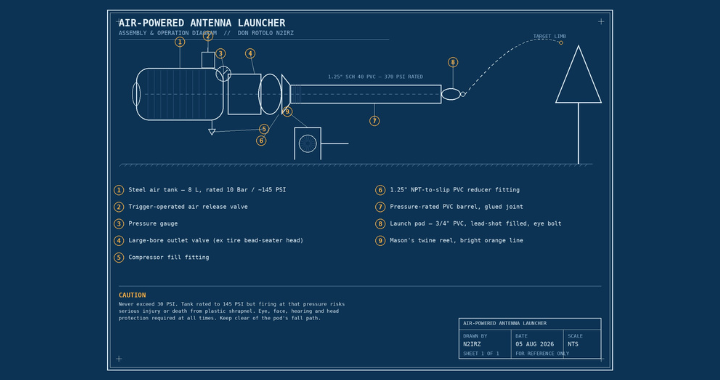
Another Air-Powered Antenna Launcher
Forget toss-bags, slingshots, arrows and the like: This inexpensive air-powered antenna launcher will put a line over a 100 foot tree with ease, accuracy and safety. IMPORTANT: I have no way to test the safety of the system described. I have made choices I feel are safer – commercial steel tank, pressure-rated PVC, etc. – but you USE THIS AT YOUR OWN RISK. The dangers include serious injury or death from high-pressure air, shrapnel from failed components, being struck by the launch pod, and contacting string, twine or rope possibly moving at high speed. ALWAYS USE PROTECTIVE GEAR INCLUDING RATED […]
Continue readingJanet Cobb Obituary
It is with deep sadness that we share the passing of Janet Cobb, beloved wife of our long-time member and club cornerstone, Bill Cobb (K4YJJ). Bill has been instrumental in NFARL’s growth, beautifully designing and managing our website through 2024, and capturing the spirit of our community for years through his event photography. A service of remembrance and thanksgiving for Jan will be held at 1:00 PM on Saturday, June 13th, 2026, at the Park Springs community in Stone Mountain. To read her full life story and leave your condolences for Bill and his family, please view Janet Cobb’s Obituary.
Continue reading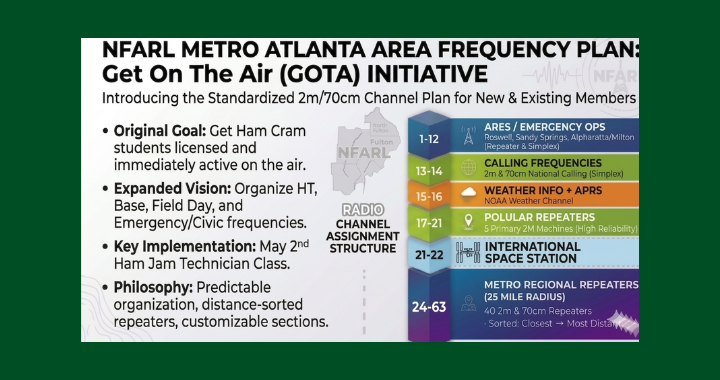
Bridging the Licensing Gap: The NFARL Metro Atlanta Frequency Plan
For many aspiring hams, the “Ham Cram” is a rite of passage — a whirlwind day of study ending in a celebratory handshake and a shiny new Technician license. But at NFARL, we kept noticing a recurring problem: a newly minted ham would walk out the door with a license in their pocket and a silent, unprogrammed radio in their hand. That disconnect sparked an idea. The “Get On The Air” Initiative The Get On The Air (GOTA) initiative was born from a simple realization: licensing is the beginning, but connectivity is the goal. Our original mission was straightforward — […]
Continue reading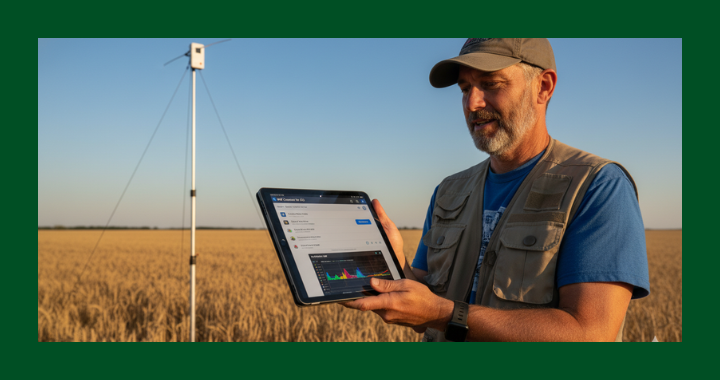
Fix for RigExpert Stick Pro Bluetooth dropout on iPad
If you use a RigExpert Stick Pro antenna analyzer with the AntScope app on an iPad and your Bluetooth connection mysteriously stopped working, you’re not alone — and there’s a simple fix. The Stick Pro is a great field tool. You can connect it directly to an antenna’s feed point, hoist it into the air, and read your SWR and impedance data from the ground using AntScope over Bluetooth. At least, that’s how it’s supposed to work. Many users, myself included, found that the BT connection simply vanished one day and no amount of rebooting or resetting either device would […]
Continue reading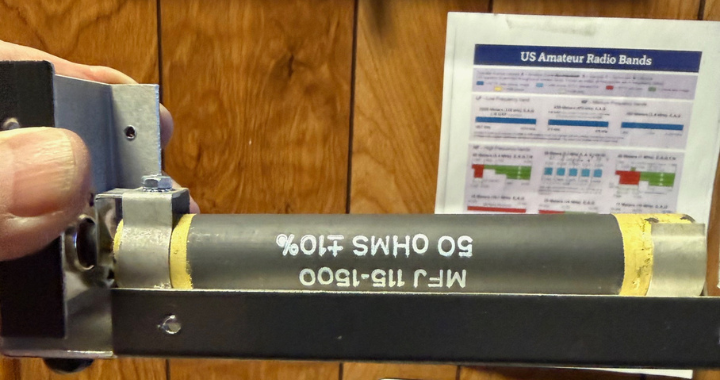
Reconditioning the MFJ-260C Dummy Load — Tips from the Bench
While numerous articles on the internet cover cleaning the aluminum case of an MFJ dummy load to improve grounding, Ted K4MPM adds a few extra considerations from his recent reconditioning of an MFJ-260C. What He Found Going In At the outset, the MFJ’s load looked alarming on the Smith Chart — the trace resembled a fender washer, and the SWR was a wavy line spanning the HF bands. A DMM reading came in at approximately 70 ohms, well off spec. A Few Things to Watch For The covers are directional. In Ted’s case, particularly with the heat shield, one orientation […]
Continue reading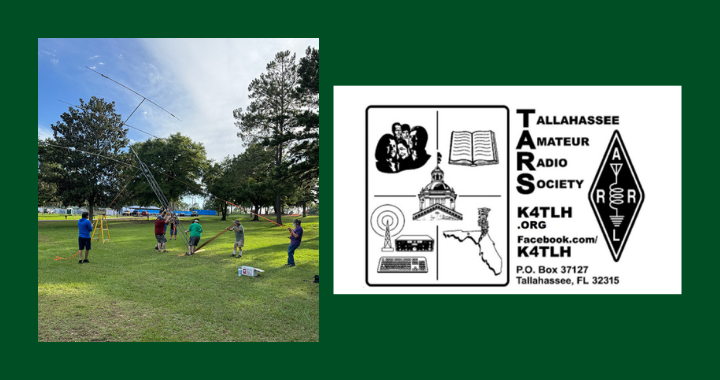
Preparedness: From Theory to Practice
This article was submitted by Jeryl Matlock, KQ4EDV. She collaborates with TARS, the Tallahassee Amateur Radio Society, accessible via k4tlh.org. TARS is a community hub for amateur radio enthusiasts. Some people group emergency management hazards into three broad categories: natural, human-caused and technological. Others in emergency management use a paradigm from the field of economics, consisting of Gray Skies, Gray Rhino, Black Swan, and Dragon King scenarios. So, what do rhinos, swans and dragons have to do with emergencies and disasters and how do I prepare myself and my family for these scenarios? That is an excellent question. The best place to […]
Continue reading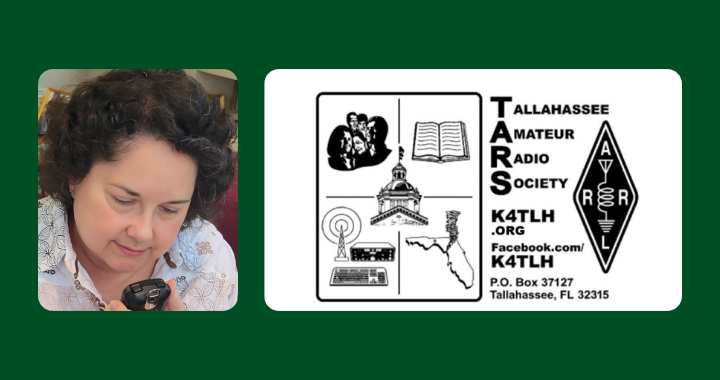
Reflections Of a New Ham Radio Operator
This article was submitted by Jeryl Matlock, KQ4EDV. She collaborates with TARS, the Tallahassee Amateur Radio Society, accessible via k4tlh.org, is a community hub for amateur radio enthusiasts. They host monthly meetings on the first Thursday of each month at 7 PM at the American Red Cross in Tallahassee, FL, fostering a sense of community and shared interest. For those looking to get involved in amateur radio, TARS facilitates license testing on odd-numbered months. Beyond formal gatherings, the group also organizes casual “TARS Lunch Bunch” meetups every Thursday, providing an informal setting for members to connect and discuss their shared […]
Continue reading
Around the Shack de N4GG May, 2025
My new end-fed half-wave (EFHW) antenna consists of a 132-foot radiating wire fed via a 49:1 matching transformer. The transformer brings the impedance of the wire to 50 ohms, more or less. It’s definitely “more or less.” EFHWs are high impedance antennas and their characteristics are sensitive to their surroundings. My store-bought EFHW came with a small in-line coil six feet out from the matching transformer. That coil is there to add a small amount of inductance to lower the antenna’s resonant frequency on 10 meters. This is a tried and true approach to getting an EFHW antenna to cover […]
Continue readingISS Station Tracker is Changing
There is now an app for that. NASA has announced that starting June 12th, the email notifications will be discontinued. Never fear, there is a great phone app available for both Android and Apple phones. Here’s a picture of the app running. Features: 1 -The upper left box tells you the next visible event. 2 – You can receive text messages of the same. 3 – The coolest feature is the globe thing. Put your finger on it and spin it in any direction. Reference: Spot the station info Enjoy and 73s, WA3TRA
Continue reading