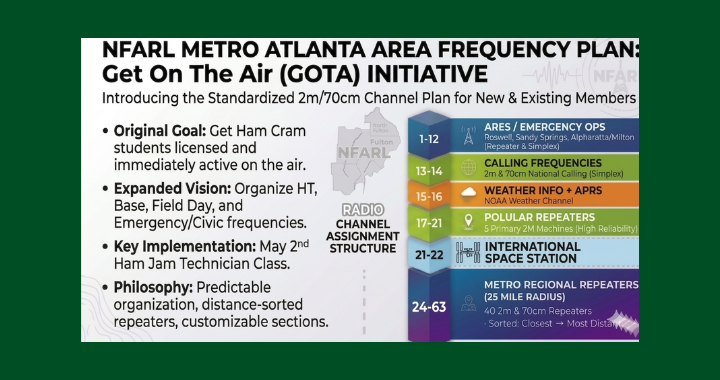
For many aspiring hams, the "Ham Cram" is a rite of passage — a whirlwind day of study ending in a celebratory handshake and a shiny new Technician license. But at NFARL, we kept noticing a recurring problem: a newly minted ham would walk out the door with a license in their pocket and a silent, unprogrammed radio in their hand.
That disconnect sparked an idea.
The "Get On The Air" Initiative
The Get On The Air (GOTA) initiative was born from a simple realization: licensing is the beginning, but connectivity is the goal.
Our original mission was straightforward — get students licensed and immediately active on the air. But we quickly learned that handing a new ham a manual and a radio with a blank memory bank was a recipe for frustration. To truly lower the barrier to entry, we needed to hand them the "keys to the city": a pre-programmed radio, ready to go from day one.
That vision grew quickly. What began as a tool for new hams evolved into a standardized frequency architecture designed for the entire Metro Atlanta community — ARES groups, local clubs, and seasoned operators alike — all looking for a predictable, organized channel plan for their HTs, base stations, and Field Day rigs.
The Architecture: 63 Channels of Clarity
We designed a 63-channel standardized frequency plan that prioritizes the most critical local frequencies while providing a comprehensive "map" of the regional RF landscape.
The philosophy is simple: predictability through organization.
By sorting regional repeaters by distance, we've removed the guesswork. Whether a ham is operating from their backyard or supporting a civic event across town, they always know exactly where to turn.
💡 Pro Tip: Channels 24–63 sort repeaters by distance from the Atlanta metro center, so even if you don't know the local geography, your radio always knows which repeater is most likely to hear you first.
The "May 2nd" Milestone
The plan isn't just theoretical. On May 2nd, during our most recent Technician license class, we officially rolled out the first release of the NFARL Metro Atlanta Frequency Plan.
Every student walked away not just with the knowledge to pass their exam, but with a radio pre-configured and ready to join the conversation immediately. No fumbling through menus. No guessing at CTCSS tones. Just key up and talk.
A Resource for the Whole Community
While this initiative started with NFARL, its usefulness extends to every radio amateur in the Metro Atlanta area.
By adopting a standardized memory map across clubs and groups, mutual aid becomes seamless. If an emergency is declared or a multi-club event is organized, everyone is — literally and figuratively — on the same frequency.
Our goal is simple: turn dead air into a vibrant, active community. With 63 channels and a standardized plan, the Metro Atlanta ham community is better prepared, better organized, and more connected than ever before.
Download the Frequency Plan for Your Radio
The NFARL Metro Atlanta Frequency Plan is available as a pre-built image file for four popular radios. Click the link for downloads:
Files are .img format, compatible with CHIRP. Open CHIRP, go to File → Load from File, and select your downloaded file to program your radio.
Don't see your radio listed? Contact us at a club meeting and we'll do our best to help.
Get Involved
Interested in obtaining a copy of the frequency plan for your radio or club? Reach out to NFARL through the contact information on this site or attend one of our upcoming club meetings. We're happy to help get you programmed and on the air.
73 de NFARL

One tweak I'd suggest is to put Call, sponsoring club, and location in the comments field for repeaters. Makes it easier to identify which repeater it is.
Great suggestion, thanks-will do!
Ben and I agreed to have the channel listing in the folder NFARL CHIRP FILE MEMORIES
Great idea and when Lee first told me about was eager to put it in action
The bad news is my radio BF K 5 plus is (upgraded UV5R).
How about putting it out there in an excel spreadsheet so it can be easily moved to our radios via Chirp
The link that is in the download as memory locations isn’t usable.
Thanks for all the effort that went into this
73 KR4LKA William “Bill” Iirwin