Sent to NFARL by Don Rotolo N2IRZ on Aug 5, 2026
Forget toss-bags, slingshots, arrows and the like: This inexpensive air-powered antenna launcher will put a line over a 100 foot tree with ease, accuracy and safety.
IMPORTANT: I have no way to test the safety of the system described. I have made choices I feel are safer – commercial steel tank, pressure-rated PVC, etc. – but you USE THIS AT YOUR OWN RISK. The dangers include serious injury or death from high-pressure air, shrapnel from failed components, being struck by the launch pod, and contacting string, twine or rope possibly moving at high speed. ALWAYS USE PROTECTIVE GEAR INCLUDING RATED EYE, FACE, HEARING AND HEAD PROTECTION. You've been warned!
Like many Hams, I sometimes need to get a line over a particular branch in a tree, typically to hang an antenna. Many years ago, I bought for this purpose what is essentially a wrist-rocket slingshot that has a fishing reel attached. Having reached that particular tool's limits – 70 feet up is all I could get with the slingshot rubbers stretched to the maximum – I started to research other options. This is what I came up with.
The slingshot was not terrible, but it had its moments. For something within its range, it worked well. With a little practice I could hit a particular spot maybe 50 feet up in less than a dozen tries. The 8-pound-test fishing line could not withstand a lot of tension, although the drag setting on the fishing reel helped. The 1-ounce fishing weights I used were hard to see, even painted day-glow orange, sometimes too light to drop back down to the ground, and I've lost several when the fishing line broke for any of several reasons. The fishing line itself was also hard to see unless you caught the light just right. Aiming was easy until you really had to pull the slingshot bands tightly for maximum range, because the strength required to do that made me shake a bit. And each shot took about 10 minutes, between the shot itself, finding if it went where it was needed, finding the weight, and pulling the mason's twine up the entire path without breaking it.
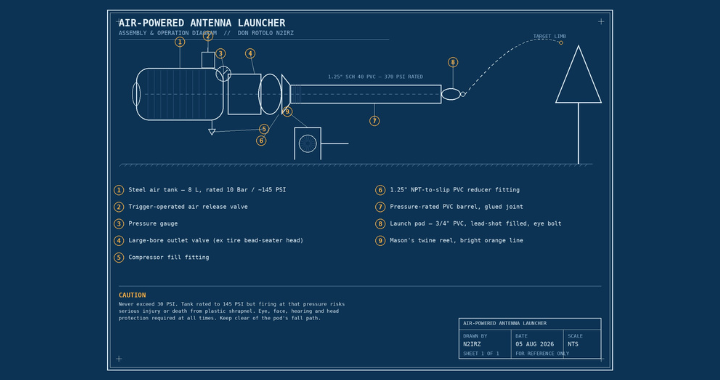
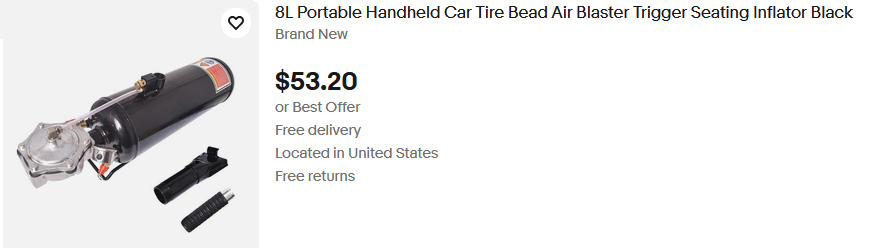
On eBay I bought a tire bead setting tool (see photo of eBay listing), which is a steel air tank equipped with a filling connection, a pressure gauge and a large trigger-operated air valve. These are used to rapidly blast a large volume of air into a tire being mounted, to set the tire beads against the edges of the rim. The steel tank has a rating of 10 Bar or about 145 PSI. It has a sturdy screw-in handle and is equipped with a standard 1.5" NPT-threaded air outlet: A Chinese bargain for about $58 with tax. I did have to replace the air-hose fitting from the industrial type to an automotive type, to match my air compressor and hoses, about a dollar from Harbor Freight.
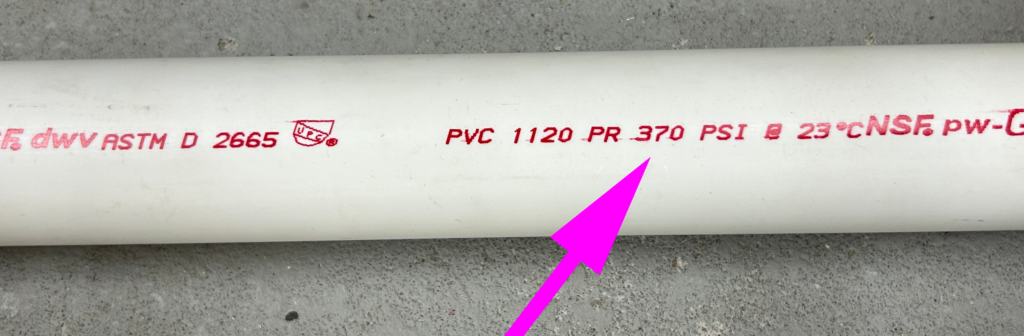
I essentially used the tool as-is, only replacing the steel pipe-based bead setting nozzle with a PVC reducer (1.5" NPT to 1.25" slip-fit) and a piece of 1.25" PVC pressure-rated pipe (see the photo for what a pressure rating looks like, here "370 PSI"), both from a local big-box store (although the hardware store probably has what you need too). With a little PVC cement (stinks like crazy!) I glued the pipe into the fitting and let it set a bit.
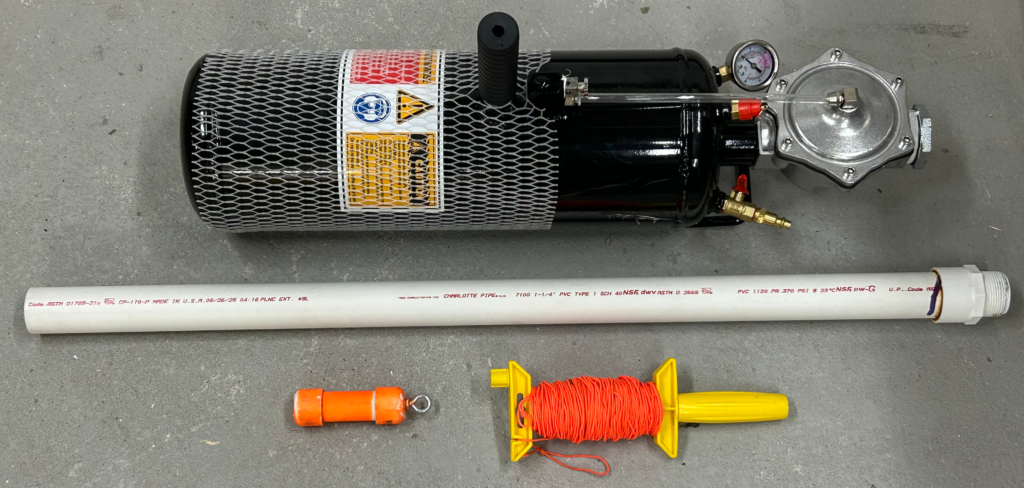
While I had the glue out, I also made a launch-pod from a short (4") piece of 3/4" PVC and two flat end caps. (The rounded-type end caps don't fit inside the 1.25" pipe, so check before you buy them). In one cap I put a small eye bolt with a nut inside and out, glued that end on, then filled it with lead shot (sand would do as well) and glued the other end on. I painted it day-glo orange to make it easier to see.
Instead of fishing line, I use bright orange mason's twine, a few dollars for 500 feet at that same big-box store. Much stronger, it is nearly impossible to break by hand, but a determined pull can break it if you protect your hands. See the photo of the whole setup.
Before you get started, get protective equipment: The launcher is loud, so use good hearing protection. Things can hit you, so wear sturdy clothes. Protect your eyes and face because things can fracture and hit you with serious force. And a hard hat is mandatory.
Using it is simple, but I recommend a few test shots to get the feel of it. Unlike some of the ham-made PVC air cannons I saw online, this tool has a very serious air valve, meaning it does not take a lot of pressure to get that little pod way up in the air. I strongly recommend starting with about 10 PSI, which might surprise you with how far it'll go.
For my first shot, I filled the tank with 40 PSI and shot the pod towards a tree (a hundred feet away). It pulled out my entire 200 feet of mason's line and dragged the reel 70 feet until it (luckily) snagged in a wire fence – I almost lost the whole thing. It took half an hour to recover: No matter what I tried, the pod was good and stuck, wrapped around a branch by the recoil of the twine when it hit the end. I wrapped a few turns of the twine around a large stick and gave it several mighty tugs, eventually throwing most of my body weight into it, until the line broke – luckily just inches from the pod. The pod fell like a stone to the ground, the bright color making it easy enough to find.
For my second shot, I filled it to about 20 PSI, tied 80 feet of mason twine (laid out nicely on the grass) to it (and to a fence) and shot straight up: It went all the way up, stretched the line and came down with a vengeance, burying itself half its length into the soil. I suspect it would have hit 100 feet or more. On 20 PSI!
Lesson learned: 20 PSI might be too much for even a 100 foot tree.
Some important points:
-
- While it's not a gun, you can hurt someone or yourself badly: Treat it like a loaded shotgun.
- The tank is rated at 145 PSI, but firing it at that pressure means you will never see the pod again, and definitely risk death or serious injury from plastic shrapnel.
- When the pod comes down, it can really hurt someone. Keep everyone away, eyes up, with a hard hat. No compromises here, hard hats and other equipment are cheap enough, a hole in your skull isn't.
- My advice: Never ever fill it past 30 PSI.
- While the PVC pipe is pressure-rated, that number is for steady, constant pressure. Firing the launcher delivers a shock load to the pipe, which could cause it (or the fitting) to fail. While very unlikely, particularly at the lower pressures I recommend, the risk is not zero: Wear eye and face protection.
- DO NOT USE PVC THAT IS NOT PRESSURE RATED. It is almost certain to burst and cause significant injury. Plastic shrapnel can be deadly or worse.