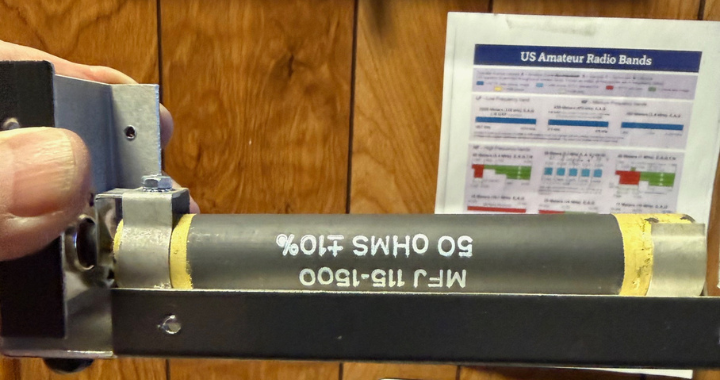
While numerous articles on the internet cover cleaning the aluminum case of an MFJ dummy load to improve grounding, Ted K4MPM adds a few extra considerations from his recent reconditioning of an MFJ-260C.
What He Found Going In
At the outset, the MFJ's load looked alarming on the Smith Chart — the trace resembled a fender washer, and the SWR was a wavy line spanning the HF bands. A DMM reading came in at approximately 70 ohms, well off spec.
A Few Things to Watch For
- The covers are directional. In Ted's case, particularly with the heat shield, one orientation provided significantly more clearance around the load resistor than the other. It's worth trying both ways before tightening things down.
- The resistor may not sit level. Ted discovered his wasn't level upon reinstallation — and wasn't sure if it had been from the factory. After several adjustments, he found that flipping the resistor "head" over achieved an almost perfect fit.
- The backmost grounding tab may not be making contact. His was touching nothing. He bent it slightly to create tension, but notes there's no real mechanism to keep it from separating again after a few heat cycles — something to keep an eye on.
The Results
After reconditioning, the MFJ now reads 54.6 ohms on a Fluke DMM. A RigExpert scan shows a ruler-flat SWR line at 1.10:1, and the Smith Chart displays a near-perfect dot across the HF ham bands.
A Word on Power Ratings
Ted suspects the MFJ-260C is happiest operating at its 100W @ 1.5-minute rating rather than being pushed to the 300W maximum — even briefly. He believes his 300W testing contributed to degradation of the "gold" coating on the resistor, requiring it to be repositioned to a fresh area.
As always… have fun!
73,
